
Alerts
What Coroot has flagged on your services, and your own alerting rules.
Alerts lists what Coroot noticed on your services: failed health checks, new errors in the logs, a database that's falling behind. It has two tabs, Alerts and Alerting Rules.
Alerts
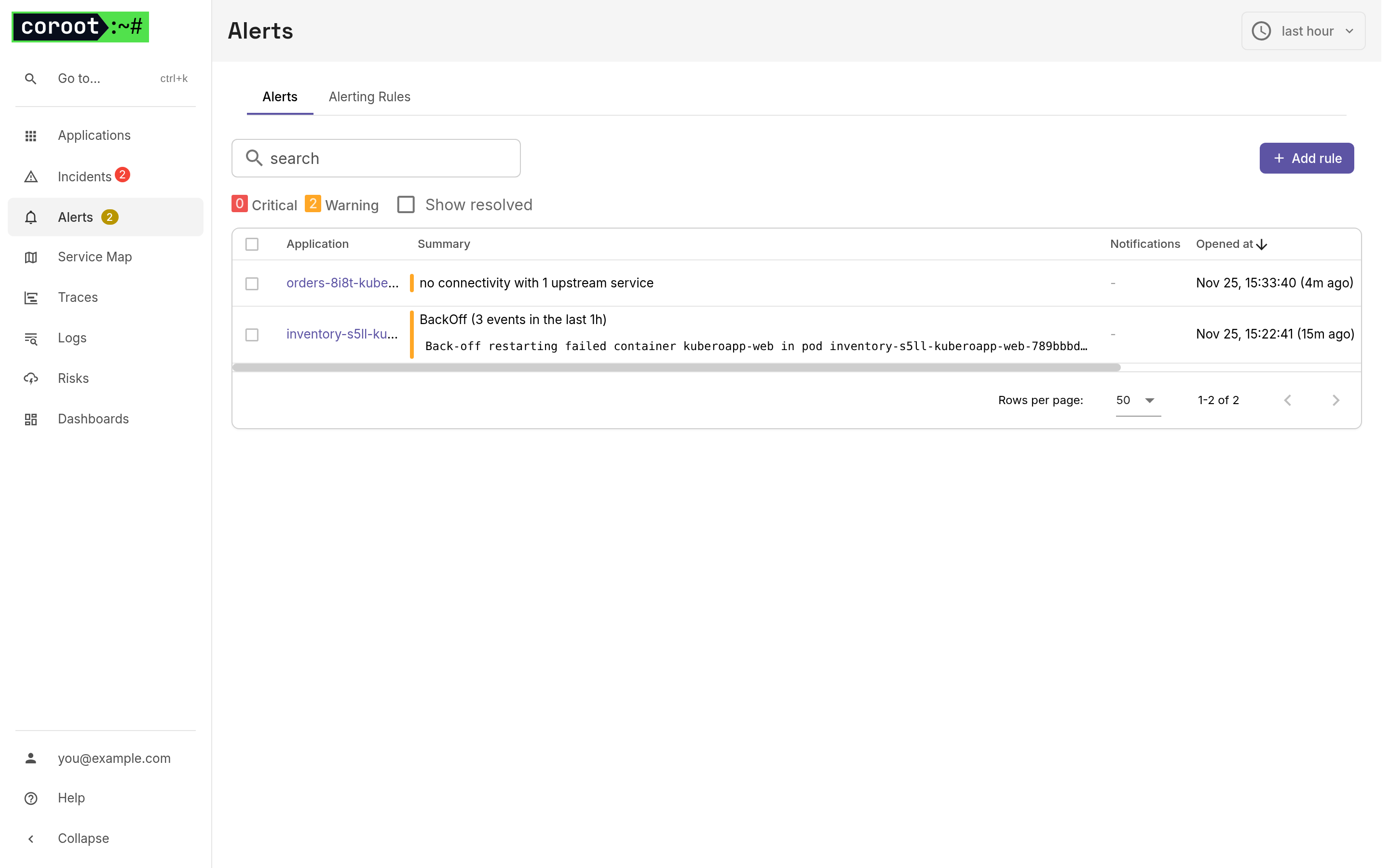
The counters show the open Critical and Warning alerts. Each row has the Application, a Summary (here "no connectivity with 1 upstream service", and "BackOff (3 events in the last 1h)" with the event's message), Notifications, Opened at, Resolved at, Duration and the Rule that raised it, such as Network connectivity and Kubernetes events here. Across all our projects we also saw Log errors ("new error in the logs") and Postgres checkpoints ("too long since the last checkpoint").
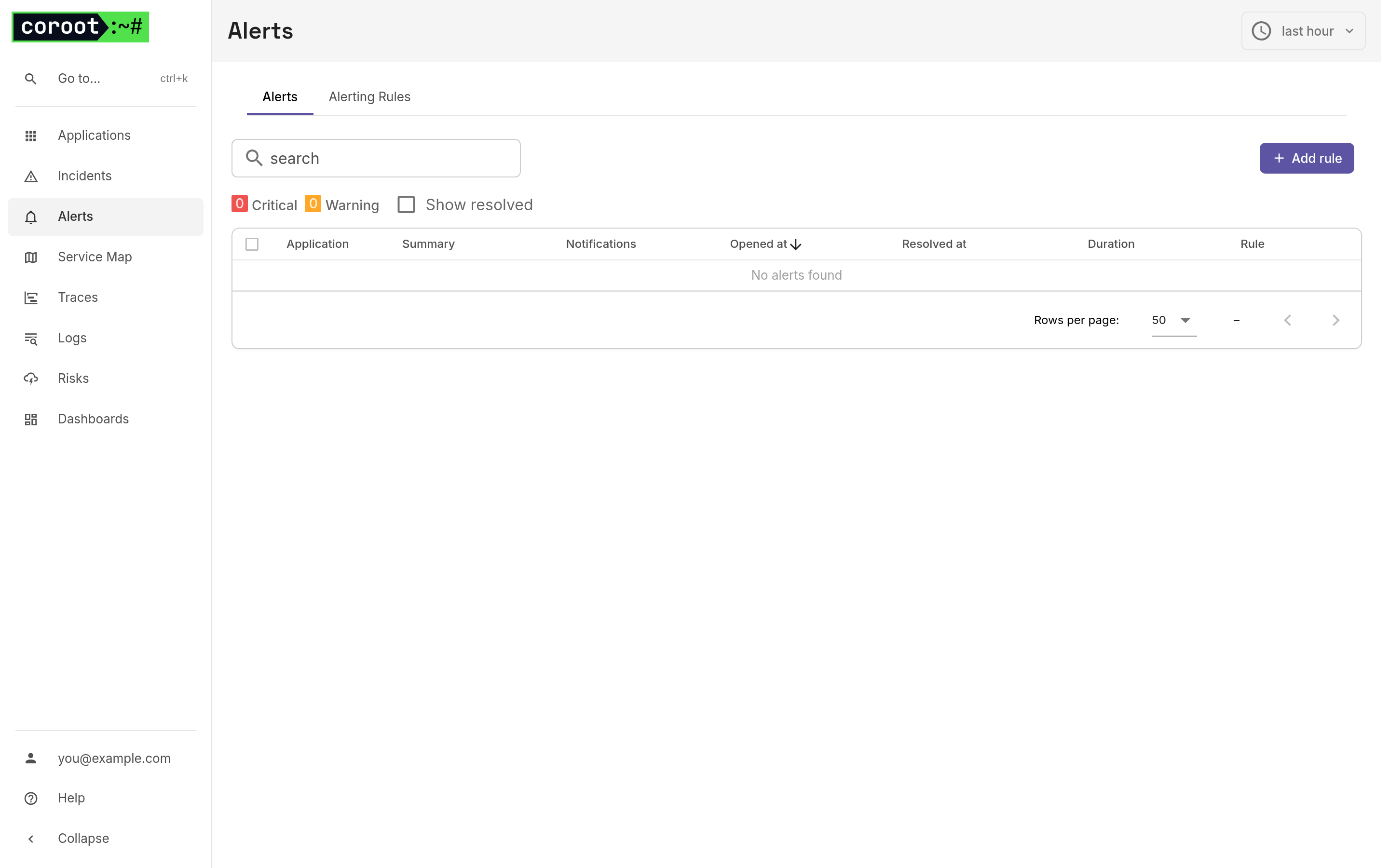
Show resolved adds the alerts that have cleared. search filters the list. With nothing to report, it says "No alerts found".
Alerting rules
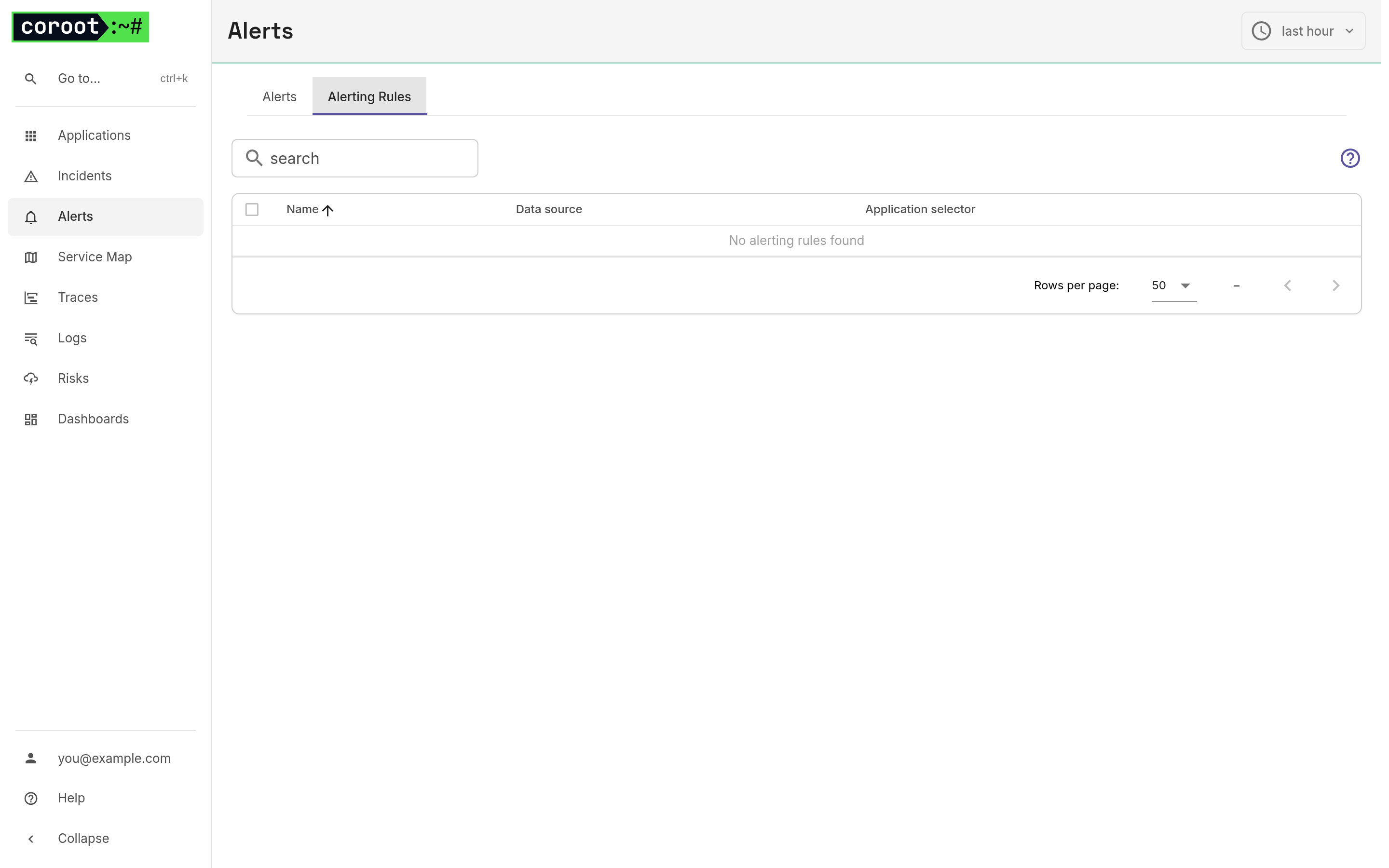
Alerting Rules lists alerting rules with their Name, Data source and Application selector. For our environments it said "No alerting rules found".
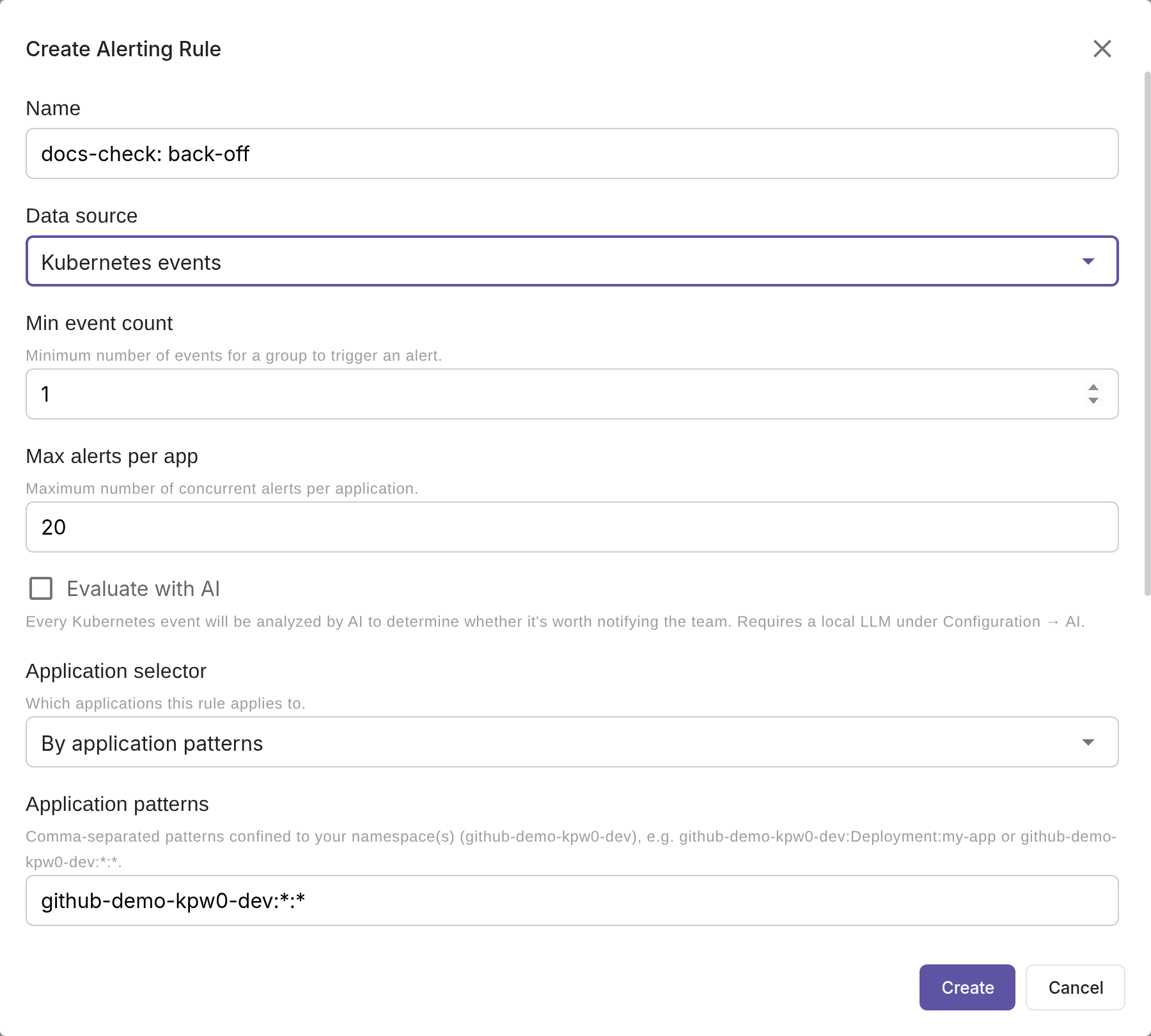
Add rule opens Create Alerting Rule:
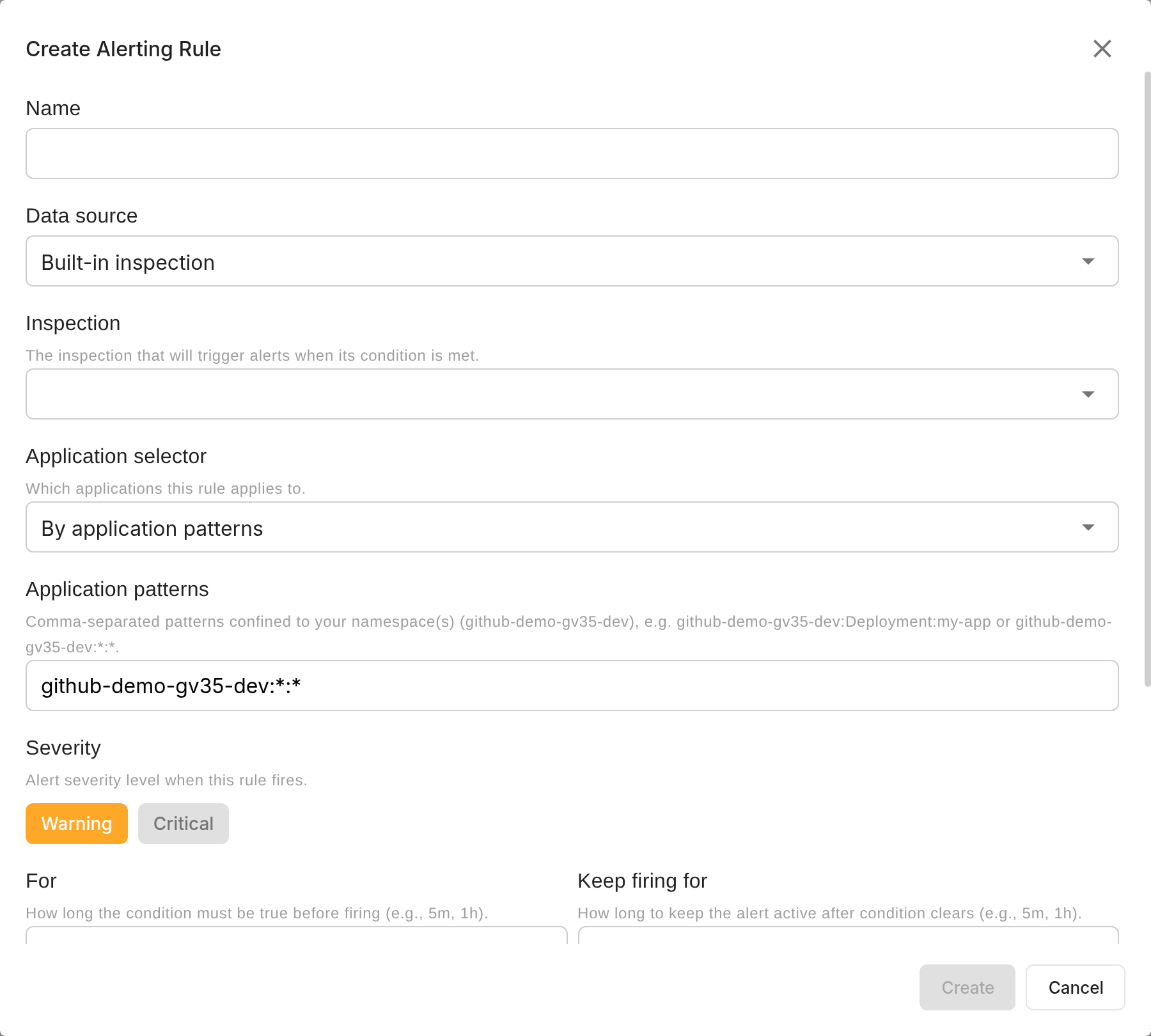
| Field | What it is |
|---|---|
| Name | The rule's name. |
| Data source | Built-in inspection, Log patterns, PromQL expression or Kubernetes events. |
| Inspection | For a built-in inspection: "The inspection that will trigger alerts when its condition is met." |
| Application selector | "Which applications this rule applies to": By application patterns. |
| Application patterns | "Comma-separated patterns confined to your namespace(s)". It starts as <namespace>:*:*, every application of your environment; github-demo-gv35-dev:Deployment:my-app would be one. |
| Severity | Warning (the default) or Critical. |
| For | "How long the condition must be true before firing (e.g., 5m, 1h)." |
| Keep firing for | "How long to keep the alert active after condition clears (e.g., 5m, 1h)." |
| Description template | "Optional detailed description of the alert and suggested actions." |
| Enabled | "Disabling the rule will resolve all its firing alerts." |
Create stays greyed out until the rule is complete. Cancel closes the form.
With Kubernetes events as the data source, Inspection is replaced by three settings: Min event count ("Minimum number of events for a group to trigger an alert"), Max alerts per app ("Maximum number of concurrent alerts per application") and Evaluate with AI, which "Requires a local LLM under Configuration → AI", a part of Coroot that isn't open to you.
A rule only ever covers your own namespaces: the patterns are confined to them.